

The Certificate III in Nail Technology (SHB30321) is the nationally recognised qualification you need to work professionally as a nail technician in Australia. It covers 15 units across manicure and pedicure services, nail enhancements, nail art, infection control and salon operations, and it can be completed in as little as six months full-time. Whether you are starting fresh or already working in a salon, this guide walks through exactly what the course includes, what it costs, and how to choose the right pathway for your situation.
Fees and practical requirements vary far more than most course comparison sites suggest, and the differences matter. Fees range from free (with the right state funding) to over A$10,000 at full price, according to 2026 published course listings from TAFE Queensland, Chisholm Institute, and TAFE SA. Practical hour requirements differ dramatically between providers. And if you already have hands-on experience, an RPL pathway could see you hold a recognized qualification in under three months. Read on for everything you need to make a confident decision.
What you need to know at a glance
- Nationally recognized qualification: SHB30321 is the standard entry-level credential employers expect from a professional nail technician in Australia.
- 15 units to complete: Ten core units cover the fundamentals; five elective units let you specialize in advanced nail art or business ownership.
- Duration varies: Expect 20 to 26 weeks full-time or 30 to 38 weeks part-time. The exact timeline depends on the provider and your study schedule.
- Placement hours differ by provider: Some require up to 250 external salon hours; others use on-campus clinics so no separate employer placement is needed.
- Government funding can cut costs significantly: Victoria confirms Free TAFE for eligible students; Queensland offers subsidized places through Career Start; NSW, WA, and SA depend on providers and
- Three study pathways available: standard enrollment, a paid traineeship, or RPL for experienced nail technicians who can document their existing skills.
What does the Certificate III in Nail Technology actually cover?
Core units: the skills every qualified nail tech must have
The 10 mandatory core units in SHB30321 build the practical and professional foundation of the qualification. You will cover manicure and pedicure services (SHBBNLS007), acrylic nail enhancements (SHBBNLS009), nail art application (SHBBNLS010), and electric file use (SHBBNLS011). These units make up the hands-on heart of the program, directly translating to the services you will perform in a salon every day.
The remaining core units address the business and safety side of salon work. SHBXCCS007 covers salon financial transactions, SHBXCCS008 covers client service, and SHBXWHS003 ensures you can apply safe hygiene, health and work practices. SHBBCCS005 develops your product and service advisory skills, while SHBBRES003 and SHBXIND003 round out your knowledge of the industry and workplace requirements.
Together, these units mean you graduate as someone who can run a client appointment from start to finish, not just apply a set of nails.
Elective units: where you specialize
The five elective units follow a two-group rule set by the qualification packaging requirements. At least one unit must come from Group A (infection control), which gives you a choice between HLTINF005 (infection prevention for skin penetration treatments) or SHBBINF002 (maintain infection control standards). At least two further units must come from Group B, and the remaining electives are selected according to the full packaging rules your RTO applies.
Two directions within Group B are worth highlighting for their commercial relevance. If you want to specialize in artistic or creative nail work, SHBBNLS012 (apply advanced nail art) is the logical pick. If your goal is to open your own studio or go mobile; the BSBESB series covers business planning (BSBESB401), resource requirements (BSBESB304), marketing (BSBESB404), operations (BSBESB406), and financial management (BSBESB407). The business electives map directly to practical tasks like writing a start-up resource plan or calculating initial operating costs, making them a useful head start for anyone with self-employment in mind.
Certificate III in Nail Technology: how the course is delivered and assessed
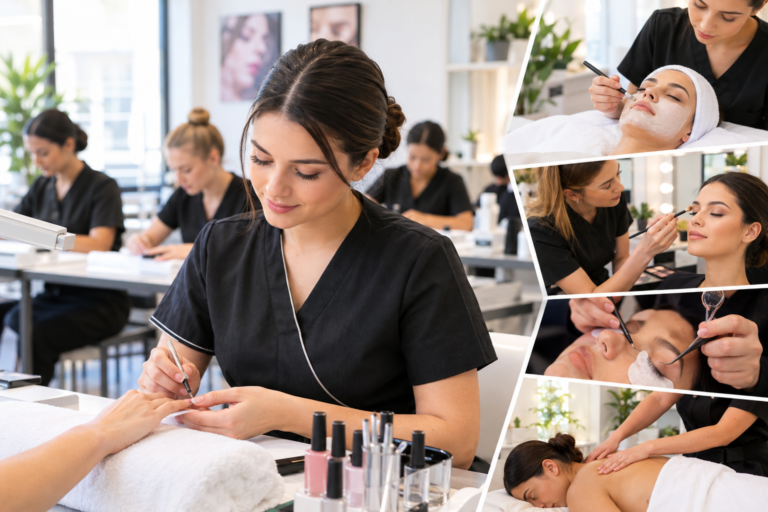
Most Australian RTOs delivering SHB30321 offer one of two main models: on-campus study (including supervised practical sessions in a college salon) or blended delivery with online theory and scheduled in-person practical components. Examples include Chisholm Institute, TAFE Queensland, and Demi International. Assessment typically combines practical demonstrations, written knowledge assessments, client case studies, and workplace portfolios. The format reflects the nature of the work; you cannot prove nail competency on a multiple-choice test alone.
The delivery model matters because it determines how you complete your practical requirements. Some providers run on-campus client clinics, allowing students to accumulate practical hours with real clients in a supervised environment without needing a separate employer placement. This is a significant advantage for students who are not yet working in a salon.
How long does the course take, and are placement hours required?
Full-time versus part-time study timelines
Full-time students typically finish SHB30321 in 20 to 26 weeks, which works out to roughly five to six months. Part-time students generally take 30 to 38 weeks, though some providers extend flexible schedules out to 12 months. These are provider-set timelines, not a single national standard, so the range is real and worth confirming before you lock in a start date.
If you are working around existing job or family commitments, the part-time timeline gives you breathing room without dragging out the qualification unnecessarily. The key question to ask any RTO is how frequently practical sessions run and whether the timetable actually fits your week, not just whether part-time is offered.
Practical hours and what “placement” actually means
This is the question that catches most prospective students off guard. Some providers, such as Open Colleges, require a minimum of 250 work-placement hours completed in an external salon across two blocks. Others complete all practical assessments through on-campus supervised clinic hours, with no employer placement required at all. Still others build practical training into scheduled class attendance. These approaches are very different commitments, and the advertised course description does not always make the distinction clear.
Before you enrol anywhere, ask the RTO directly: are the practical hours external salon placement, supervised on-campus clinic time, or in-class attendance? Get the answer in writing. If you do not have a salon willing to take you on for placement, a provider that runs its own client clinic is the more straightforward option.
Where can a nail technology qualification take your career?
Roles you can step into after graduating
SHB30321 graduates most commonly move into employed nail technician roles in dedicated nail or beauty salons, mobile nail artist work with private clients, or positions within broader beauty teams offering nails alongside other treatments. Each setting has a different rhythm. In a salon you work set hours with a steady client flow; as a mobile operator you control your own bookings and travel to clients; as part of a broader beauty team you may deliver nails alongside other services the business provides.
According to Jora and Indeed salary data for 2026, starting wages for newly qualified technicians sit at roughly A$28 to A$32 per hour as a permanent employee, based on Hair and Beauty Industry Award classifications. More experienced technicians and those in premium salon locations or high-demand markets earn considerably more. The qualification is the employer-expected entry point; completing it through a quality training provider puts you in the best position from day one.
Further study and business ownership options
SHB30321 is a strong foundation, not a ceiling. The most direct next step is the SHB40121 Certificate IV in Beauty Therapy, which adds waxing, facials, massage, lash and brow treatments, and advanced skin services to your skill set. Beyond that, SHB50121 Diploma of Beauty Therapy covers senior treatment and business skills and opens doors to roles such as salon manager or spa therapist. For those who want to expand across the beauty space before committing to a higher qualification, SHB30121 Certificate III in Beauty Services is a useful bridging option.
If you chose the business elective units within your Cert III in Nail Technology, you already have a running start on the foundational knowledge for self-employment. The diploma is the more appropriate qualification for those aiming to manage or own a broader beauty business over the longer term.
Is a traineeship or RPL the smarter route for you?
How a nail tech traineeship works
A traineeship is a formal training contract between you, a salon employer and an RTO. You complete paid work in the salon while the RTO delivers training and assessment alongside your employment. The financial advantage is significant: you earn an income during your qualification rather than studying without pay. Depending on your state and employer, the training fees may also be covered or substantially reduced through government funding tied to the traineeship arrangement.
If you already have some nail skills, ask the RTO to assess RPL at the start of the traineeship. Recognised competency can reduce the number of units you need to complete through training, though it does not automatically shorten the contract period itself. The traineeship path suits people who want structured training, workplace experience and a wage throughout the process.
Certificate III in Nail Technology, RPL pathway: timeframe and typical costs
Recognition of Prior Learning (RPL) lets an RTO assess your existing skills and knowledge against the qualification units, rather than requiring you to sit through training you have already effectively completed. The process involves submitting evidence: your résumé, employer references, work records, previous certificates and photos or videos of your work. The assessor reviews that evidence, conducts an interview or practical demonstration, and identifies any gaps. A well-organised portfolio can be assessed in four to six weeks after submission; the full process, including gap training, may take up to three months.
Gap training, reassessment and materials may be charged separately. Choose RPL if you already perform the required services confidently and can document it well. Choose a traineeship if you need structured training and hands-on workplace experience to build your skills from the ground up.
What to do next: enroll in a Certificate III in Nail Technology
The Certificate III in Nail Technology is a practical, achievable qualification with a direct outcome: a nationally recognised credential and the hands-on skills to work professionally in any Australian salon or build your own mobile business. Standard enrolment, a paid traineeship and RPL each suit a different starting point, and the right choice depends on your current experience, schedule and financial situation.
Government funding can significantly reduce what you pay, from free tuition in Victoria for eligible students through to subsidised co-contributions in Queensland and potential support in NSW, WA and SA. Always confirm in writing whether the specific provider and intake is funded before you enrol, and ask for a full cost breakdown that includes consumables, kit and student fees.
Entry requirements for SHB30321 are minimal at a national level: no prior qualifications or industry experience are required. Individual providers may ask for an LLN or LLND skills assessment and confirm basic digital readiness before enrolment, and some set a minimum age of 16 or 17. These requirements are about matching you to the right support level, not filtering out capable applicants.
When you are ready to move forward, contact your shortlisted RTOs and ask for written confirmation of their RTO scope, available funded places for the 2026 intake, and a complete fee breakdown covering tuition, consumables and any additional charges. Funded places fill faster than most students expect, so confirming the details early is the most practical step you can take.
Frequently Asked Questions
Do I need any prior qualifications or experience to enrol in Certificate III in Nail Technology?
No, there are minimal national entry requirements and no prior qualification or industry experience is required. Some providers may still ask for an LLN or LLND skills assessment, basic digital readiness and a minimum age (usually 16 or 17) to make sure you receive the right support.
Can we work or earn while completing the qualification?
Yes, you can earn while you complete the qualification if you do a paid traineeship, because a traineeship is a paid training contract with an employer. Traineeships suit people who want structured workplace experience and a wage while training; standard enrolment or RPL do not automatically include paid employment.
What should we confirm with an RTO about practical hours before enrolling?
Confirm whether practical hours are external salon placement, supervised on-campus client clinic time or in-class practical attendance, and get that answer in writing. Practical arrangements vary widely, some providers require up to 250 external placement hours while others provide all supervised client experience on campus, so knowing the format affects your ability to complete the course.
If we already have nail skills, how long does the RPL process usually take?
A well-organised RPL portfolio can be assessed in about four to six weeks, and the full process including gap training may take up to three months. Be prepared to submit evidence such as your résumé, employer references, work records and photos or videos of your work, and expect an assessor interview or practical demonstration.